
Last updated: September 27, 2026 · Product details checked against manufacturer and official retailer listings
Affiliate disclosure
Some links on this page may be affiliate links. If you buy through one, we may earn a small commission at no extra cost to you. It never changes what we recommend. Read our full disclosure.
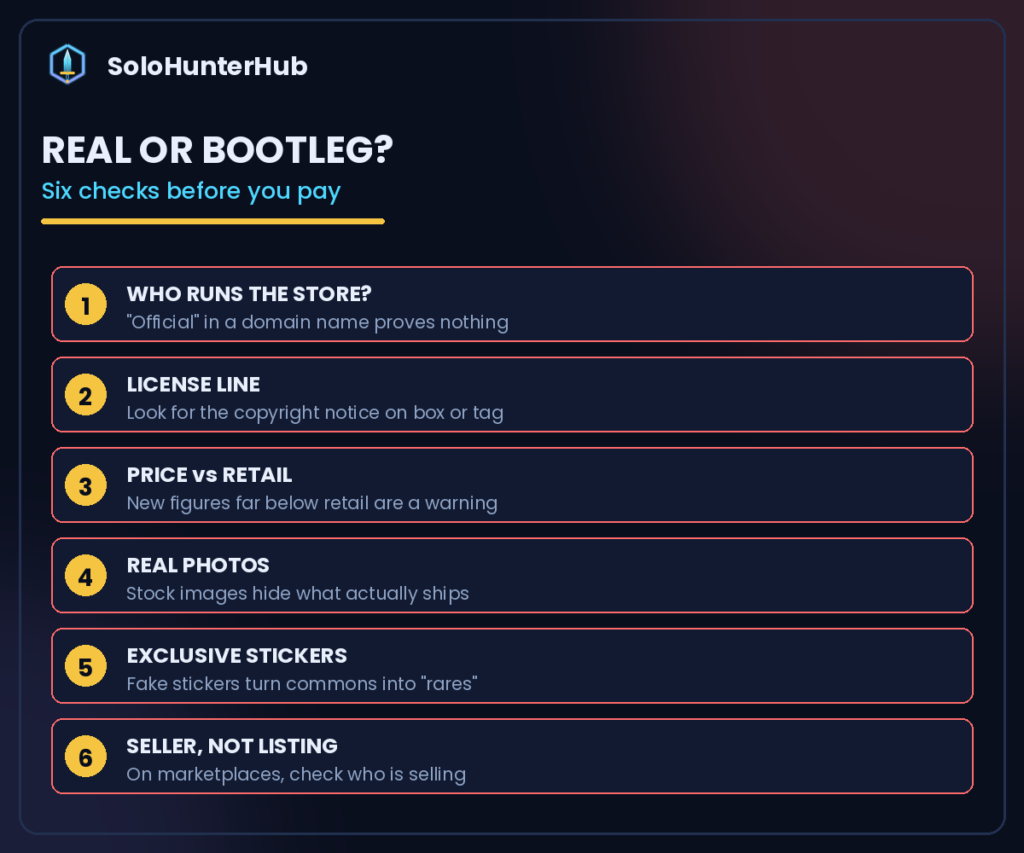
Six checks catch most fake Solo Leveling merch: who runs the store, the license line on the packaging, the price against retail, real photos, figure-specific quality signs, and — for Funko Pops — the exclusive sticker.
The most common trap is not a bad figure. It is a website with “official” in its name that has no connection to the rights holders.
| Detail | Answer |
|---|---|
| Most common trap | “Official” store websites |
| Fastest check | License notice on box or tag |
| Funko risk | Counterfeit exclusive stickers |
| Figure risk | Bootleg paint and plastic |
| Marketplaces | Check the seller, not the listing |
Table of Contents
Why Solo Leveling Merch Gets Faked So Often
Popularity outpaced licensed supply. When Season 1 made Solo Leveling one of the most-watched anime in the world, official products could not keep up — and unlicensed sellers filled the gap. Figures, Funko Pops, and apparel are all affected, each in different ways.
Check 1: Who Actually Runs the Store?
The single most common trap is a website with “official” in its name. A domain name costs a few dollars and proves nothing. Official Solo Leveling merchandise comes through the Crunchyroll Store, the manufacturers themselves, and established retailers.
Our read
If you have to ask whether a store is official, it usually is not. Genuine rights holders do not need to put “official” in their URL — they are Crunchyroll, Funko, and Good Smile. Treat a standalone “official Solo Leveling store” as a fan print shop until proven otherwise.
Check 2: The License Line
Licensed anime products carry a copyright notice on the box, tag, or packaging — for anime-based merchandise this commonly credits the production committee as ©Solo Leveling Animation Partners.
A missing notice is not proof of a fake, but it moves the burden of proof onto the seller.
Check 3: Price Against Retail
Look up the manufacturer’s price before buying. A brand-new scale or non-scale figure selling far below what the manufacturer charges is almost never a bargain. Used and opened items are different — but a new, sealed figure at a fraction of retail is the most reliable warning sign there is.
Check 4: Real Photos, Not Stock Images
Bootleg sellers routinely use the manufacturer’s own promotional photos. Those images show the real product, not the one that will arrive. Ask for photos of the actual item — box and all — and walk away if the seller refuses.
Check 5: Figures Specifically
- Paint: bleeding colours, smudged eyes, uneven edges
- Plastic: overly shiny, lightweight, or soft material
- Box: blurry printing, wrong fonts, spelling errors, missing manufacturer logos
- Stickers: many Japanese manufacturers use authenticity stickers or holograms — check the maker’s site for what theirs looks like
Check 6: Funko Pops Specifically
Funko fakes are less about the figure and more about the sticker. A standard Pop with a counterfeit exclusive or chase sticker can be sold for several times its value.
- Match the box number to the exclusive — the exclusive usually has its own number or a distinct variant
- Compare the sticker’s shape, colour, and font against the official retailer’s photos
- Check that a claimed chase actually shows the chase feature — glow, metallic finish, or alternate colour
- See our Funko checklist for which retailer each exclusive came from
Apparel
Anyone can print a design on a blank shirt, so the tag and the seller matter more than the design. A generic blank-shirt brand label on something sold as “official” is a clear mismatch. Our apparel guide lists the licensed lines.
Marketplaces: Check the Seller, Not the Listing
On large marketplaces, genuine and unlicensed versions of the same item can appear on the same page from different sellers. The listing title tells you nothing. The seller name tells you almost everything.
If you already bought a fake
Contact the marketplace or your payment provider promptly — most have buyer-protection windows that close after a set period. Keep the listing screenshots and the item photos.
Frequently Asked Questions
How can I tell if a Solo Leveling figure is fake?
Check the seller, look for the license notice on the box, compare the price to the manufacturer’s, ask for real photos, and inspect paint quality, plastic, box printing, and authenticity stickers.
Are “official Solo Leveling store” websites real?
Usually not. A domain name proves nothing. Official merchandise is sold through the Crunchyroll Store, manufacturers such as Funko and Good Smile, and established retailers.
How do I spot a fake Funko Pop?
Most Funko fakes involve counterfeit exclusive or chase stickers on standard Pops. Match the box number to the exclusive, compare the sticker to official photos, and confirm the chase feature is actually present.
What copyright notice is on official Solo Leveling merch?
Anime-based products commonly credit the production committee as ©Solo Leveling Animation Partners on the box, tag, or packaging.
Is it a fake if the price is much cheaper than retail?
For a brand-new sealed figure, a price far below the manufacturer’s is the most reliable warning sign. Used or opened items are a different case.
Are all Solo Leveling resin statues bootlegs?
No, but many resin statues sold online are unlicensed garage kits from independent studios. Confirm the maker holds a license before paying.
What should I do if I bought fake Solo Leveling merch?
Contact the marketplace or your payment provider quickly, since buyer-protection windows expire. Keep screenshots of the listing and photos of the item.
Sources
- Manufacturer authenticity guidance
- Official retailer product listings
- Marketplace buyer-protection policies